
Reducing and Stabilizing Nitrogen Across the Wellfield
Nitrogen dilutes methane, drags down heating value, and on RNG sites it's often the hardest spec to process. Unlike methane and carbon dioxide, it isn't generated by the waste, it's air pulled in through cover, leaks at the wellhead, and preferential pathways whenever applied vacuum runs ahead of what the landfill is producing. The common response is to throttle back, but cutting vacuum to manage nitrogen also gives up the collection, emissions, and odor control that vacuum was applied for in the first place.
Nitrogen is also a moving target. The same well can read low levels one week and elevated the next as cover settles, weather shifts, liquids move, and the waste mass changes around it. That variability is the hardest part to manage, and a wellfield tuned once a week or once a month is reacting to a reading that is already out of date.
Why Monthly Tuning Falls Behind
Manual tuning is periodic by nature. A technician walks the field, reads each wellhead, makes an adjustment, and returns days or weeks later. Conditions drift in between, a well dialed in on the last visit can spend most of the month pulling air or starved for vacuum, with no indication until the next reading.
For nitrogen, that lag is costly. Air intrusion can develop quickly, and on a less frequent sampling interval the system may dilute gas for weeks before the problem surfaces. Taking hourly or daily samples by hand, across dozens or hundreds of wells, isn't practical.
How smartWells Manage Nitrogen
smartWells automate wellhead tuning at the device level. Each unit takes a sample up to once an hour and adjusts its valve with every reading, holding the setpoints an operator defines.
Measurements include:
Gas quality (CH₄, CO₂, O₂, balance gas)
Flow
Pressure (static, differential, and system)
Gas and ambient temperature
Barometric pressure
The control algorithm balances user set priorities to: reduce O₂ and balance gas intrusion, maintain the vacuum needed for compliance and odor control, sustain methane flow, and refine that equilibrium continuously as site conditions change.
Two design choices keep the data reliable:
Balance gas is calculated, which includes nitrogen, hydrogen and other trace gases.
Auto-calibrating gas sensors and auto-zeroing pressure sensors, so the readings behind each adjustment stay accurate over time.
Because balance gas is calculated and accounts for nitrogen, minimizing balance gas effectively minimizes the nitrogen collected. Stable, predictable nitrogen lets operators set realistic targets, distinguish a true trend from normal noise, and make decisions with confidence. It also protects plant performance, since a steady feed is far easier to manage than a moving target. Automated control improves both, and the reductions seen in variability are consistently the most significant improvement from automation.
Site-Level Results
The following are RNG sites with an existing nitrogen rejection unit (NRU), each with smartWells installed in October 2023. Across all three sites over their almost 3 operational years, you can see an increase in energy recovery and reduction in balance gas variability.
Site | smartWells Installed | Increase in Energy Recovery | Balance Gas Variability Reduction | Additional RNG Value / Month* |
Oklahoma | 75 | +17.62% | −45.26% | $287,400 |
Pennsylvania | 115 | +12.91% | −25.05% | $610,900 |
Florida | 142 | +11.02% | −31.78% | $382,000 |
*RNG value assumes $26 per mmBTU.
Oklahoma Site:

Pennsylvania Site:

Florida Site:

Across very different sites and field sizes, the pattern holds: more gas collected, balance gas that swings less, and a recurring increase in RNG value.
Pacific Northwest Site:
A Pacific Northwest RNG site with 80 smartWells demonstrates similar results. Average nitrogen fell from 7.63% to 6.46%, while nitrogen variability (standard deviation) dropped from 5.29 to 3.56, indicating the gas is roughly a third more stable.
Metric | Pre-Apis Average | Post-Apis Average | Results (% Change) |
Nitrogen (N₂%)* | 7.63% | 6.46% | -15.31% |
Nitrogen Variance (St. Dev.)** | 5.29 | 3.56 | –32.78% |
*Nitrogen: represents the average nitrogen concentration (N₂%) in collected gas.
**Nitrogen Variance: reflects the standard deviation of all nitrogen readings, showing how stable nitrogen is over time.
Well-Level Results
Site averages can mask what happens at an individual wellhead, so it's worth looking closer.
A single well, before and after: Balance gas ran anywhere from 0% to 27% with no reliable pattern. After a smartWell was installed, variance dropped roughly 80% (5.44 to 0.93) and balance gas settled near 6.8% for the year.
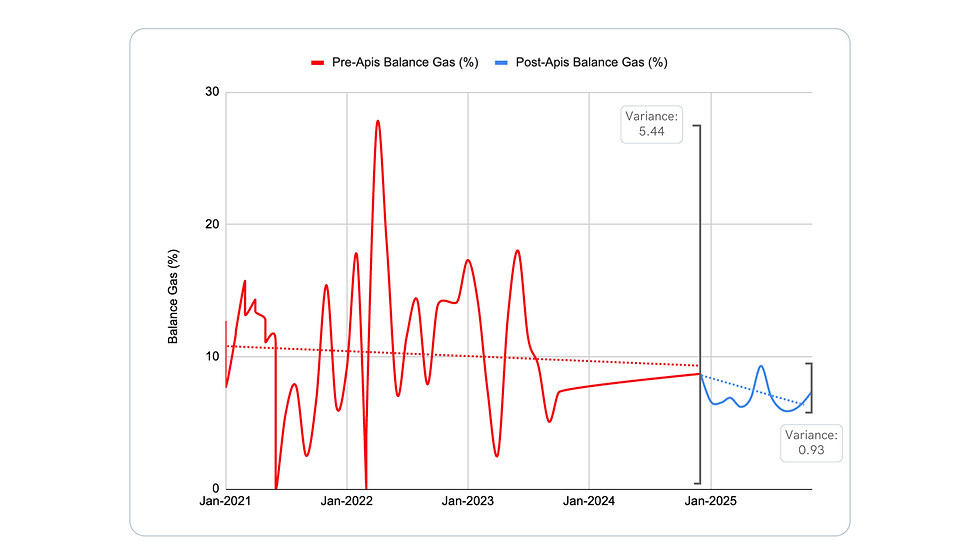
Pre- and post- balance gas readings on one well equipped with an Apis device.
The valve at work: Over one week of continuous adjustment, a smartWell increased methane flow while holding balance gas steady near 4%, with a nitrogen sample variance of just 0.44. The valve works constantly, keeping the well within its target band as conditions shift through the day.

Valve position, methane flow, and balance gas over a week at one smartWell.
What to Expect
Automation does a great deal, but it isn't the whole picture. Nitrogen is also influenced by factors no single wellhead controls; site operations, cover integrity, and overall landfill health. The strongest results come from pairing the technology with sound site management: setting realistic targets, monitoring against them, and adjusting as the landfill evolves.
In our experience, sites with methane concentrations between roughly 30% and 60% have the most to gain from automation for beneficial use projects. If that describes your wellfield and nitrogen is cutting into gas quality or RNG value, there's typically meaningful room to improve.
Want to see what automated nitrogen control could look like on your site? Contact us for a consultation or request a site assessment.

